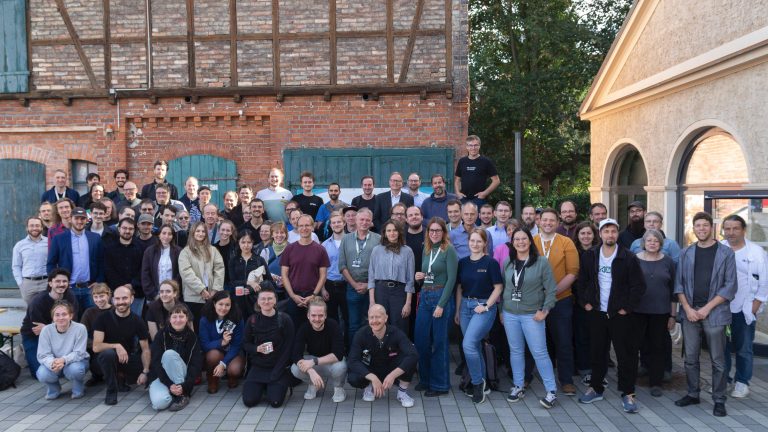
On 23rd and 24th September 2026, the open-source hardware community gathered at the Steintor Campus in Halle for the annual OSHOP conference.
Here are some impressions from Jess and I (Sigrid).
OSHOP, the Open Source Hardware Innovation Platform, is backed by HTW Dresden, TU Dresden and Fraunhofer IWU. It brings together people from the OSH community and raises awareness of the topic within the business sector – particularly amongst small and medium-sized enterprises – as well as in schools, vocational training programmes and universities. Consequently, it has a large network of partners and supporters.
The range of topics covered during those two very intensive days – in talks and workshops, as well as at the stands featuring project presentations and in discussions amongst the participants – was correspondingly broad.
Here is a brief overview of the programme.
Open Source in Public Administration
Tobias Krüger from the Ministry of Infrastructure and Digital Affairs of the State of Saxony-Anhalt (LSA) provided an overview of the topic of open source in public administration.
His keynote speech made it very clear just how difficult change is, even when there is a widespread recognition that technological sovereignty begins with the ability to make one’s own decisions and to switch providers. There are many agreements and a complex structure involving the EU, the federal government, the federal states and local authorities, as well as the various ministries.
A federal modernisation agenda, which includes open source, is intended to drive the whole process forward. This encompasses open standards, documented interfaces, independent operation, the ability to switch away from a system and other aspects. User acceptance is key here; users must be won over by systems that work effectively.
What we have taken away from this is:
It’s all about interoperability, interchangeability and reusability, where solutions are not reinvented time and again, but are reused by others.
Open Source in Start-ups
Start-ups have an easier time of it in this respect, as they can set up their processes from scratch, as Benedict Diederich from OpenUC2 in Jena demonstrated in his keynote speech ‘Why Open Source Hardware as a Business Foundation Is Not a Bad Idea’. In keeping with Jena’s reputation, the focus is on optics.
OpenUC2 is focused on harnessing the modularity of open source to make education and innovation in optics more accessible across the board, with what he calls ‘the arduino of microscopes.’ Instead of adding a new standard, they’ve developed a cube system which makes existing lenses interoperable. With most of their income coming from selling educational kits and finished products for research, he noted one challenge is keeping up with documenting design updates enough for reproduceability. They focus less on absolute reproduceablilty, opting instead for contributing to the accessible development of more open designs. He also shared the story of getting OpenUC2 started in his spare time next to full time work. His advice to anyone in the same position is not to do two things at once, but to dive in all the way sooner than he did. Since then, the team has grown to fourteen people, many of whom got started initially through their repository.
There are also companies that have prioritised openness and transparency from the very start, without realising straight away that this makes them an open-source company.
Take OpenScan from Halle, for example, where Thomas Megel turned his hobby – 3D scanning for a wide variety of applications – into a business. As part of a community of people interested in 3D scanning, he exchanged information with them on technologies, possibilities and sources for DIY projects. What began as a joint ordering of parts and documentation for construction has grown into a company that is also further developing the technology. The 3D scanners are modular, and their quality is constantly being improved in collaboration with the open-source community. He described the challenges that arise when making the transition from a hobby to a business, and believes this is a good approach if you want to expand the reach of technologies and possibilities.
Thomas Megel has now taken openness one step further. He has made his cost calculations transparent, so that everyone can understand how the prices are arrived at. Being part of a community is therefore reflected not only in the technology, but also in how a company is run.
What we’ve learnt:
Open-source hardware can be used to build businesses. In fact, it offers advantages because innovations are driven forward in collaboration with the users.
Open Source Hardware Community
Sid Drmay, Community Manager at OSHWA, the Open Source Hardware Association, joined the event via video link to talk about their experiences in setting up and developing OSHWA.
OSHWA began by organising summits, which have been held regularly ever since. These include the general OSHWA Summit, which took place in Berlin this year, as well as specialised events such as the Open Healthware Conference. OSHWA is the source of a definition of open-source hardware that is widely used.
As well as Open Healthware, the certification of OSH products is another area of activity.
Sid Drmay has invited everyone to the 24-hour Open Healthware Lifestream on 10 October 2026. (The link and further information are yet to be published.)
Our takeaways:
There is a lot going on in the community, and although it is global, its members meet regularly online and offline to exchange ideas.
Presentations and workshops
A collection of papers based on the presentations will be published; we will let you know as soon as it is available.
As for the workshops, we intend to publish separate blog posts later on about some of the projects and topics covered at the OSHOP 2026 conference.
Conclusion
To conclude, we’ll let one of the participants have their say: “So, how was your first open-source hardware conference?” “It was pretty cool.”