This blogpost is from Jessica. It describes the project which introduced her to Open Source Hardware.
Thank you, Jessica!
It started when a woman lost her menstrual cup, the only kind that fit her, and found out that it wasn’t made anymore. She told a friend who decided to try and redesign it for her. For a mechanical engineer involved in open hardware, how hard could it be? Of course, it turned out to be more complex than she thought.
So the friend started asking for advice and telling people about it. At an OSEG meeting, she caught another woman’s interest who saw this idea as an opportunity to explore social entrepreneurship with open source hardware. They could develop not only the design but ways of getting the design to where it was needed. So their interests aligned, and they began working together. Interactions like this continued to happen as the idea was brought up in more settings, until there was a team of five working on it together.
Network mapping process
I became the sixth to join when I found the group while looking for a case study for my post graduate thesis. A community organiser turned business student, I wanted to learn about collective social innovation through network mapping. Luckily, this interest led me to discovering open source hardware.
My research collected both network and narrative data about the group through three phases:
- team brainstorm of major project themes,
- individual network mapping interviews with the two initiating team members, and
- an in-person team network mapping workshop.
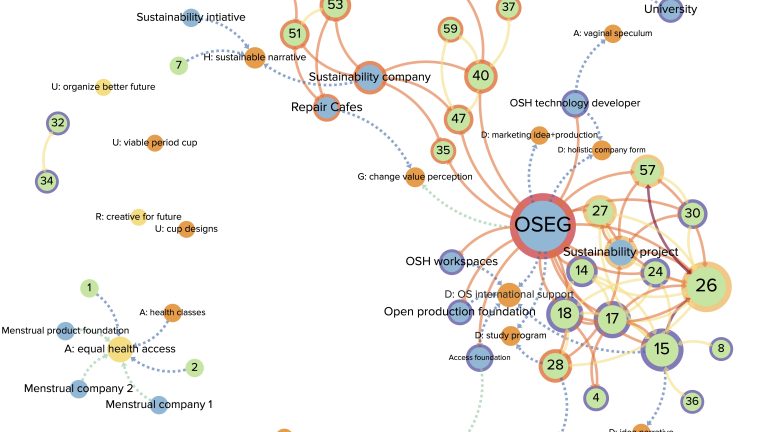
The individual network maps were only made up of people and organisations, but the team map included more narrative node types. To make it, each person wrote down their purpose for collaborating on the project, and these became the base nodes in the network (yellow nodes). Everyone then discussed current and future goals for the project and also added them in (orange nodes). Now, people and organisations were added into the network (people=green, organisations=blue) if they also had the same goal or purpose (dashed blue line), or if they could support a goal or purpose (dashed green line).
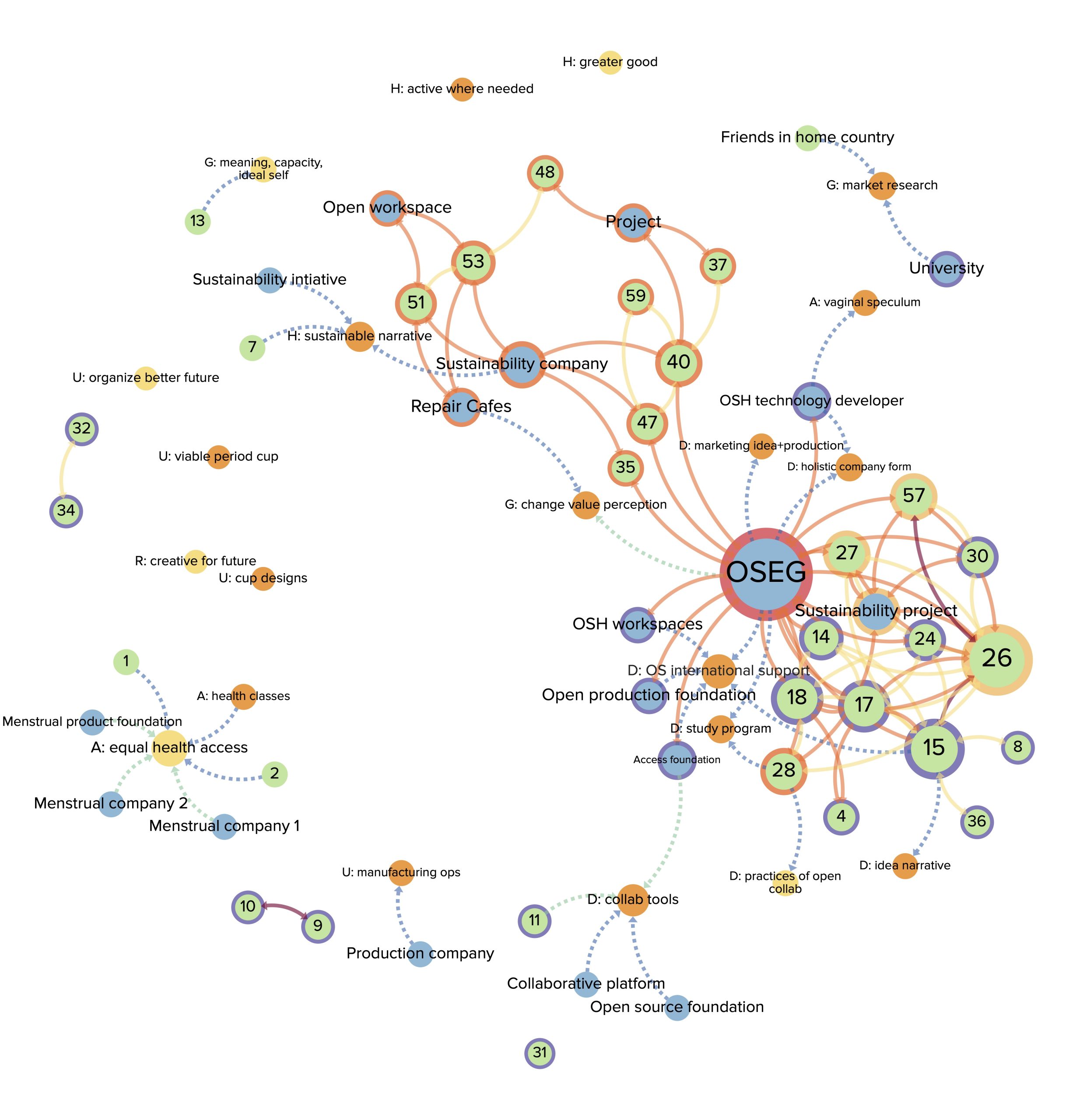
Explore the dynamic maps here
The result of the combined maps was a visualization not only of people and organizations which were relevant to the period cup initiative, but their connections to the causes and motivations of the team, alongside the steps to take to move the hopes for the project forward. It became clear that the will to join the project had a lot to do with a will to contribute solutions to experienced challenges. Although the challenges that motivated each team member were different, the connected team network made it more possible to act together on the causes which got each person involved.
Building collective awareness
Its hard to figure out what’s possible when you don’t actually know who you are, what you know, or who you know that can help you. Doing this as an individual is one thing, but quite another as a collective. This is why mapping can be a helpful tool for groups to get to know themselves as a new whole, made up of diverse capabilities, connections, and identities that open new doors when organized together.
Engineers get input from and collaborate with people who have knowledge of local needs that might only be addressed with altered specifications or modularity. Community builders learn of collaborative open source ecosystems and start utilizing them. Designs informed by diverse perspectives are developed in tandem with models of organization which might make them sustainable to implement where they are needed, not just where they could make a profit. This overlapping may only happen if the right people can find the project, understand the meaning behind the designs, get to know each other, and see a way that they can make contributions even if they aren’t directly of a technical nature.
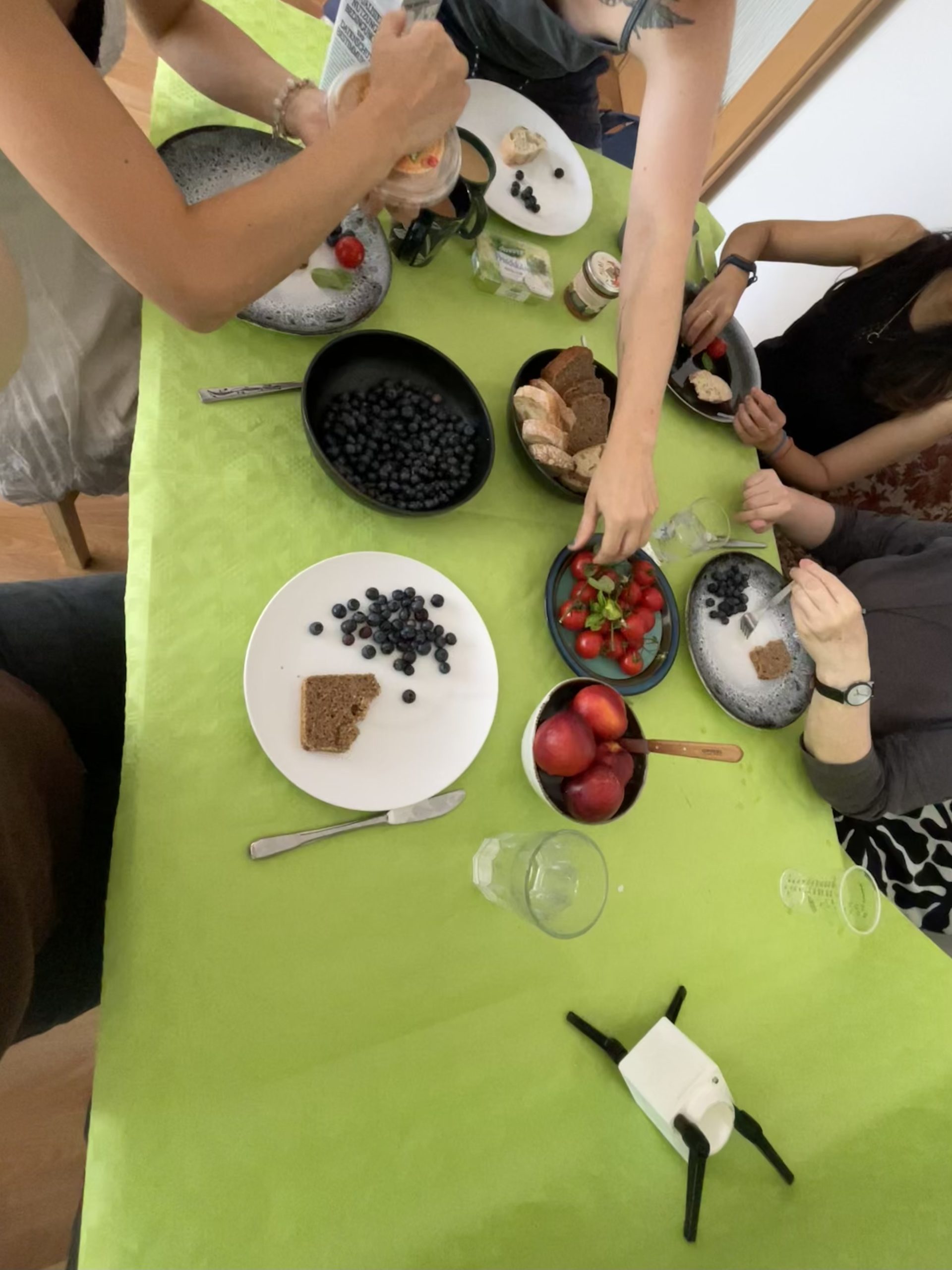
Team enjoying snacks after our first documentation session, with an in progress period cup setting at the head of the table
In the case of the period cup initiative, the technical capacity of one person became an enabler for a community to connect and start taking action. We all had pre-existing hopes of contributing to causes important to us, but we were missing a solution to implement, people to do it with, the right knowledge, connections, or capacity. The open source structure gave us each a way to start contributing even before we knew what open source hardware really meant, because for most of us our contributions so far are to the communication, research, community development, and knowledge of needs areas, rather than to the technical design.
Through the process though, we’re learning about CAD files, documentation standards, Maker Spaces, and Repair Cafes. We’re working with Codeberg, wechange, and collaborating on Pads in Markdown. We’ve gotten to know the open source hardware ecosystem that has made projects like ours so much more possible.
What we already have
It doesn’t take long to notice the central role OSEG plays in the network map, and shows how facilitating exchange and community also between projects can be the difference between an idea seeming possible or not. The OSEG organizational node is the best connected by far, but the individuals around it are also the most tighly connected to each other. For the times when attempting to contribute to change feels futile, being a part of a community that continuously supports each other to experiment with what might be possible can make all the difference.
Interested in network mapping? I tried to design a modular process in hopes that it could be adapted for other projects as well. For a closer look, visit the work in progress repository, but if you have questions or want to give it a try, please get in touch!