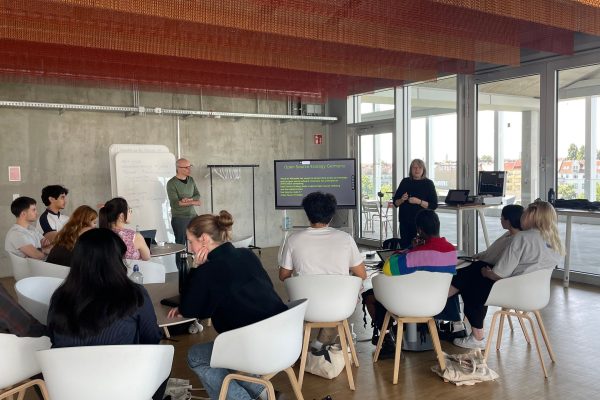
Bits & Bäume’s mission is to bring digitalisation and sustainability closer together. At this year’s Bits & Bäume Summit 2026 on 6 June 2026, the network of supporting organisations met with its community to discuss developments over recent years and the challenges ahead. I attended as a representative of OSEG and was impressed by the wide range of talks, workshops and discussions on offer – and, above all, by the many conversations I had.
Here are a few impressions:
In her keynote speech, Friederike Rohde from the Department of Sociology of Technology and the Environment at the BTU Cottbus-Senftenberg provided an overview of what has happened since the first Bits & Bäume in 2018. She highlighted current key debates: the scale of the planned infrastructure changes requires enormous resources, turning digitalisation into a global issue of justice: who benefits and who pays the price? A more local approach is needed here, including the funding of alternative digital infrastructure.
Some of these issues were explored in greater detail during the subsequent presentations, workshops and discussions. The topics ranged from geopolitics – for example, how AI and military systems are linked to the nuclear infrastructure used to meet the energy needs of data centres – to specific examples of projects and topics discussed by the Bits & Bäume regional groups.
A major issue are data centres, with their high water and energy consumption, as well as the difficulty in obtaining sufficient information about them. Only when the locations are known and the relevant data is publicly available can civil society play a part in the planning process. This is vital because the local population could face water supply shortages and higher energy prices.
This involvement of civil society has proved difficult. In some cases, the proposals and demands do not seem to reach the intended recipients in politics and administration at all; in others, the responses state that other bodies are responsible for these matters. This leads to great frustration within the initiatives and networks and to a search for other ways to give these demands greater weight.
For me, as someone who is very interested in open-source hardware, one of the concepts presented – public benefit stewardship for digital commons – was a real eye-opener. Just as the long-term maintenance of open-source software, the verification of data and content, the publication of algorithms and much more must be guaranteed. This is true for open-source hardware, too. Repairs, spare parts, manuals and documentation, bills of materials and sources of supply, are examples of what must be made available and accessible in the long term. Do we also need to introduce OSH stewards?
My general impression: A lot has been done already, but as digitalisation is progressing, the amount of work to be done is increasing.
All of this was also reflected in the closing panel, and it was noted with appreciation that there is an increasing number of concrete projects and strategic alliances, for example involving open-source hardware in the field of energy.
The commons have always been a good way of working collaboratively and in line with needs.