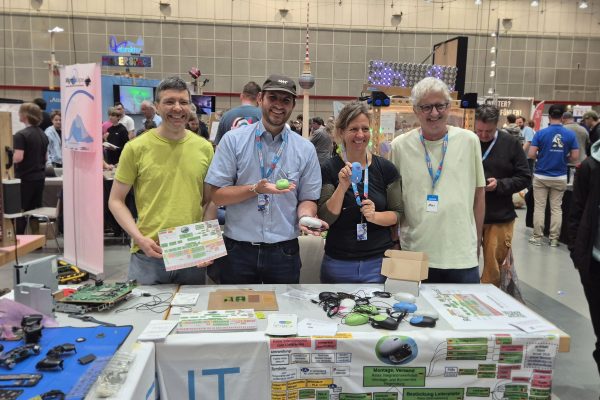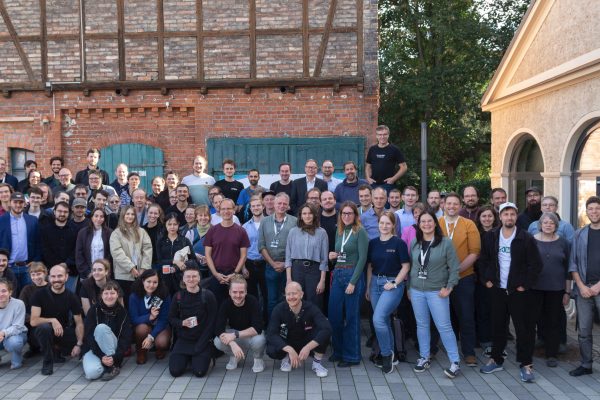
As someone new to OSH, I felt that spending two days at the Open Hardware Summit attuned my vision to a world of possibility I hadn’t noticed before. Products are no longer singular objects, but clusters of parts that can be reused, repaired, or modified. Suddenly, daily items are no longer opaque systems that I don’t have a say in: my broken vacuum cleaner is far from being trash, my shoes are inspiration for my own footwear experiments, backyard lamps can be tinkered into protest lasers with a bit of patience, and even challenges in my community look more like invitations for collaborative innovation.
Open Footwear – To make is also to repair

I was interested in the Open Footwear workshop because it was so accessible: we all know and use shoes, what changes when they’re open source? One thing that stood out was Juraj’s story about running in his shoes for race after race until the soles wore out. Normally you would simply get a new pair, but since he made the shoes in the first place, he had the glue and knew how to get and cut the material. It simply made more sense to just replace the sole himself and keep running. A seemingly obvious light bulb went off in my head at that moment: if you’ve made it yourself, repairing it becomes the natural next step. Discarding items we already know how to fix no longer makes the most sense: our perception of value and our awareness of our own competence is changed. So I’m going to make some shoes.
AirGradient – The open source hardware advantage

On the topic of OSH businesses, in the 50.000 Devices Later talk it struck me how much less extractive scaling businesses which are based on openness can be, at least in AirGradient‘s case. He talked about the advantages that open source has from a manufacturing perspective, but the points on this list could also be seen as reasons why OSH business is better for communities too. He mentioned the doing away with non-disclosure agreements, money going not into ads and sales but accessible innovation, focus on actions with maximum impact, the need for constant meaningful innovation, and the importance of helping to build capacity with and educating stakeholders. Conversations about scaling OSH projects don’t seem to detach from scaling solutions for communities too, which may be an additional advantage worth noting.
This is an article by Jessica Hellmuth. She says about herself:
I am an artist, community organizer, and facilitator of bodily expression. I’m quite new to open source hardware, but I’m drawn to it as a way for people to take matters into their own hands by working together. I am an active member of the OSEG project for menstrual cups, which I joined while researching participatory network mapping.