
This year, the OSHWA Open Hardware Summit came to Germany. It was hosted by TU Berlin. This provided an opportunity for many OSEG members to attend.
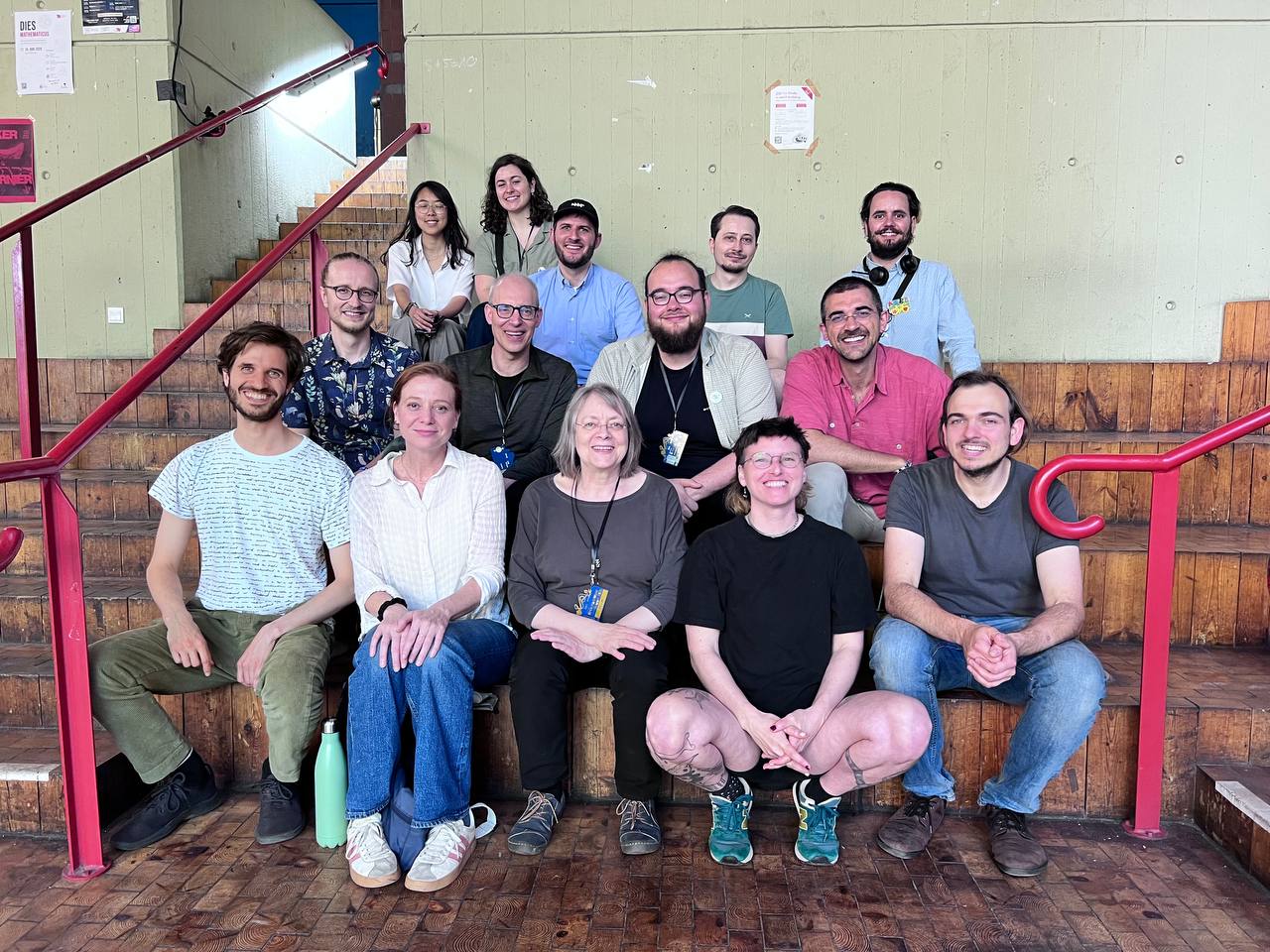
Here, Flo and Sigrid tell you all about their experiences at the Open Hardware Summit. We’ve moved Jessica’s impressions to a separate post.
You can find another summary of the summit from hackster.io here.
Flo
A total of four talks were organised by and featuring members of the association.
Together with Victoria Wenzelmann and Susan Long, Timm presented the Maker Emergency Kits: an ecosystem for the rapid, community-led production of essential tools in times of crisis.
Sara introduces the HILO Spinning Machine and the broader concept behind open-source yarn production and research.
Holger and his team-mates Thomas Weiß and János Adelsberger presented the Caznic, a state-of-the-art vacuum cleaner that is modular and hackable.
Sizou and Sigrid, along with their colleagues (Yana, Linh, Phuong and Jessica), put their OSH menstrual cup on the agenda. A truly eye-opening presentation that highlighted, on the one hand, the issues surrounding disposable menstrual products in developed countries and, on the other, the lack of access to these products in developing countries – and, above all, the need for reusable alternatives.
In addition to technical and scientific topics, there were also contributions from the worlds of art and culture.
I had in-depth discussions and made new contacts.
These included Achim Haug, founder of AirGradient; Juraj Šuška, initiator of the Open Footwear project; and Thomas Megel from OpenScan.
We’re sure to see a few familiar faces again at the OSH conference in Halle this autumn.
Sigrid
Sculptural Soldering Workshop
The two days were intense. I came away with: fascinating talks, brilliant workshops, great inspiration, lots of good and interesting conversations, helpful tips and new contacts. One workshop broadened my horizons: I soldered myself a flashing pendant – my first ever soldering project. Now I see shapes everywhere, and I instantly have ideas on how to turn them into objects.
Discussions: Manufacturing – Why manufacturing needs to change and become more open
I find this topic particularly relevant to OSH. After all, there are plenty of ideas, but how do you turn them into products and businesses? One of the key points raised in the panel discussion was that, whilst everything is pre-determined in large factories, smaller manufacturers are flexible and able to find new solutions quickly. Ideally, this is done in close collaboration with other (local) producers and the community. People play the leading role here, drawing on their knowledge, creativity and ability to cooperate. In this way, skills that have been lost through industrial manufacturing can even be brought back. This could lead to greater diversity in manufacturing methods. Matchmaking platforms should be set up so that the openness and exchange typical of OSH companies can act as a catalyst for faster innovation.


2 thoughts on “Open Hardware Summit 2026”